Master Your Finances: The Minimalist Budgeting Pack
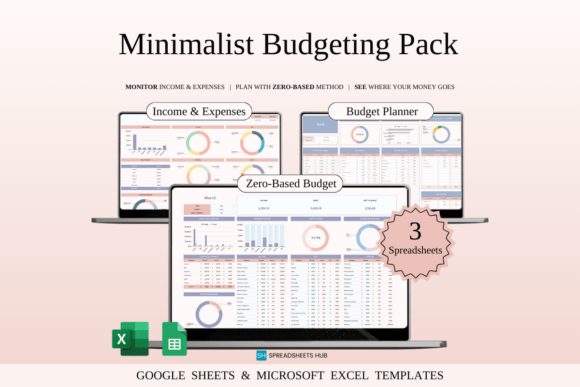
Let’s be honest. Most financial tools feel like they were designed by accountants, for accountants. They are dense, overwhelming, and often feature more gridlines than a geometry textbook. If you are a creative professional, a busy entrepreneur, or simply someone who values clean aesthetics, staring at a chaotic spreadsheet can feel more like a chore than a solution. This is where the Minimalist Budgeting Pack | 12 Templates changes the game. It strips away the visual noise, offering a streamlined, intuitive approach to money management that respects both your time and your visual sensibilities.
A Visual Language of Clarity
The first thing you notice about this collection is the restraint. In a world of flashy graphics and cluttered interfaces, the Minimalist Budgeting Pack | 12 Templates embraces whitespace. It functions like a beautifully designed sans serif typeface—clean, legible, and highly functional. The visual personality is calm and authoritative. It doesn’t scream for your attention; instead, it guides your eye naturally to the data that matters. This design philosophy is crucial for financial tools. When you remove the visual clutter, you reduce cognitive load. You aren't fighting the interface; you are simply entering numbers and seeing results.
The style relies on a strict grid system and a monochromatic color palette, which creates a sense of order. Think of it as the typographic equivalent of a perfectly kerned logo. Every column has a purpose, and every row aligns to create a harmonious rhythm. This isn't just about looking pretty; it is about creating a user experience that encourages consistency. If the tool is pleasant to use, you are far more likely to stick with it. The overall appeal lies in this sophistication—it looks professional, mature, and ready for real-world application.
Practical Application: From Spreadsheets to Strategy
While this is a collection of Spreadsheet Templates in Excel & Google Sheets, the principles behind it mirror those of great editorial design or brand identity work. Just as you would choose a specific typeface to set the tone of a magazine, you choose a budgeting layout to set the tone of your financial life. The Minimalist Budgeting Pack works best in environments where efficiency is paramount.
Consider the modern creative agency or the freelance designer. You are juggling multiple clients, tracking software subscriptions, and managing project-based income. A cluttered financial dashboard is the enemy of productivity. These templates function like a premium font family—versatile and reliable. You can use the "Zero-Based Budget" template for intense strategic planning, much like using a bold display font for a headline, and the "Income & Expense Log" for daily tracking, similar to a readable body text font.
For small business owners, the ability to toggle between Excel and Google Sheets is a massive advantage. It offers the flexibility required in modern web design and digital workflows. You can access your data on the go, just as you would access your design assets from the cloud. The templates are not rigid; they are adaptable frameworks. They allow you to project a sense of control and organization, which is vital for brand perception. When you know exactly where your money is going, you make better decisions, much like how knowing your font pairing options leads to better design execution.
Strategic Integration for Professionals
Choosing a financial system is a lot like choosing a creative font for a major campaign. It needs to fit the project's specific needs. The Minimalist Budgeting Pack is ideal for those who value modern typography principles: hierarchy, balance, and legibility. Here is how to evaluate if this toolkit fits your workflow:
- Evaluate Project Fit: Just as you wouldn't use a script font for technical documentation, don't use a complex accounting software if your needs are straightforward. This pack is designed for personal finance, freelancers, and small businesses. It provides the structure of a serif font—reliable and traditional—but with the speed of a sans serif.
- Readability and Hierarchy: Good financial data requires a strong visual hierarchy. The templates use bold headers and distinct sections to separate different types of expenses. This mimics the way a skilled designer uses weight and spacing to guide a reader through a page. It ensures that your "bottom line" is always visible and legible.
- Consistency is Key: In branding, consistency builds trust. The same applies to budgeting. The uniformity of these templates helps you build a habit. Whether you are tracking packaging design costs or monthly rent, the interface remains the same. This consistency reduces friction and helps you maintain a professional standard in your financial record-keeping.
The Art of Simplification
There is a distinct power in simplicity. In logo design, the most iconic marks are often the most reduced. The Minimalist Budgeting Pack applies this same philosophy to your bank account. It doesn't try to be a tax preparation suite or an investment portfolio manager. It focuses on the core function: tracking what comes in and what goes out.
This focus allows for a level of clarity that more complex systems often obscure. When you strip away the unnecessary features—the "fluff"—you are left with pure utility. It is a commercial font equivalent in the world of spreadsheets: professional, polished, and ready for business. Whether you are a blogger tracking ad revenue or a crafter managing supply costs, the tool adapts to your narrative. It empowers you to take control of your finances with the same confidence you bring to your creative work. By adopting this clean, structured approach, you transform budgeting from a dreaded task into a streamlined part of your professional routine.